Background music for hotels:
the complete guide to hotel audio branding

A modern hotel builds its identity across many layers: architecture, lighting, furniture, scent, staff behaviour, digital experience. Sound is the one layer that most properties still overlook, yet it operates continuously from the moment the guest walks through the door to the moment they leave. This guide covers the seven-touchpoint sonic journey of a hotel stay, how to handle multilingual guest communication without hiring additional staff, and why the direct licensing model removes the administrative overhead of dealing with collecting societies like PRS for Music, PPL and their international equivalents.

Running a hotel group, a boutique chain, or a single flagship property? The tailored quote includes multi-zone management, multilingual announcements, dedicated music curation and direct licensing documentation. Response within 24 hours.

🇮🇹 Questa pagina è disponibile anche in italiano

Sound is the layer every hotel forgets

A hotel invests heavily in the visual and tactile dimensions of the stay: the lobby design, the bed linen, the bathroom finishes, the scent of the hallway. The sonic dimension receives a fraction of the same attention, and yet it's the one layer the guest perceives continuously, without interruption, from arrival to check-out.

Walk through any hotel in the world and observe what the guest actually experiences through their ears. At check-in, most of the time it's either silence (which feels cold) or a generic commercial radio station with advertising (which is jarring and off-brand). In the corridors, silence again, broken only by the sound of the elevator motor and other guests' doors. In the breakfast room, sometimes a playlist the property's food and beverage manager compiled from their own Spotify account years ago. At the bar, the music changes because the bartender has put their own selection on. At the spa, a generic ambient file that could belong to any spa in any country. There is no coherence, there is no intention, and there is certainly no brand. The irony is that the same property has spent months choosing the colour of the lobby sofas to match the brand identity.

A well-designed audio environment does the opposite. It ties the entire guest journey together with a continuous, curated sonic thread that reinforces the property's identity at every moment. The lobby, the corridor, the breakfast room, the bar, the spa, the restaurant, the check-out area: each has its own mood adaptation, but all of them are recognisably part of the same sonic world. The guest who moves through the building doesn't notice the transitions consciously — good sound design is almost always invisible — but the cumulative effect on their impression of the property is significant. Research in hospitality marketing consistently shows that guests who describe a hotel as "refined" or "calm" or "welcoming" are partly responding to its sonic environment, even when they don't explicitly attribute their feeling to the music. The Italian version of this page, opportunità del turismo e ruolo della musica in hotel, covers the same subject for the Italian hospitality market with the same seven-touchpoint framework.

The seven-touchpoint sonic journey of a hotel stay

From the moment the guest walks through the revolving door to the moment they hand back the key, there are seven distinct sonic touchpoints in a typical hotel stay. Each has its own role, its own mood, its own communication needs. A well-designed hotel radio addresses them as an integrated sequence, not as isolated playlists.

01
Touchpoint 01

Arrival and lobby

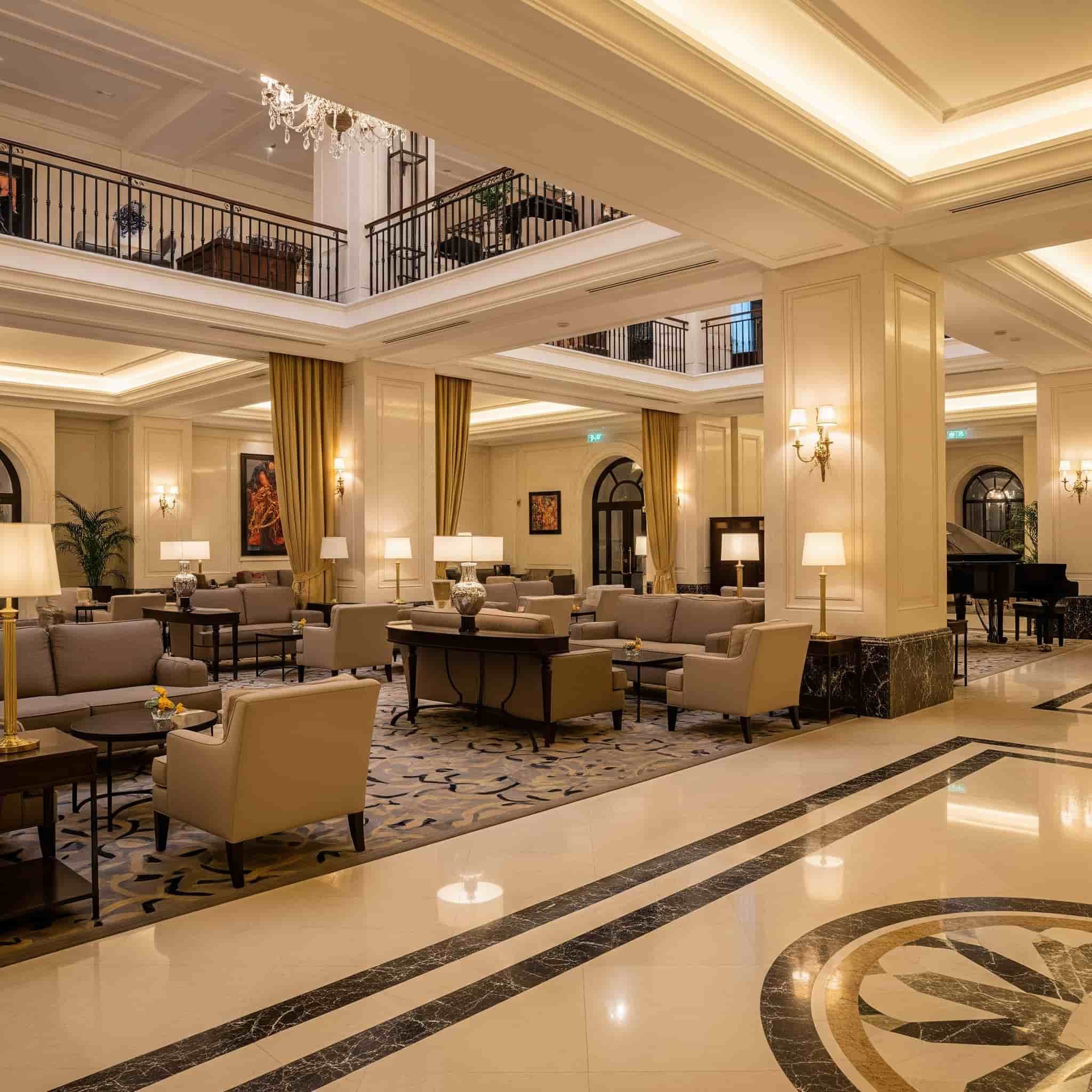
The first impression. The guest has just travelled — possibly for hours — and is carrying fatigue, expectation, and a residue of the outside world. The lobby is where they drop that residue and step into the property's atmosphere. The music here is the first voice the hotel speaks to them, and it sets the tone for everything that follows.

Role: welcome, reassure, signal quality.
02
Touchpoint 02

Check-in and front desk

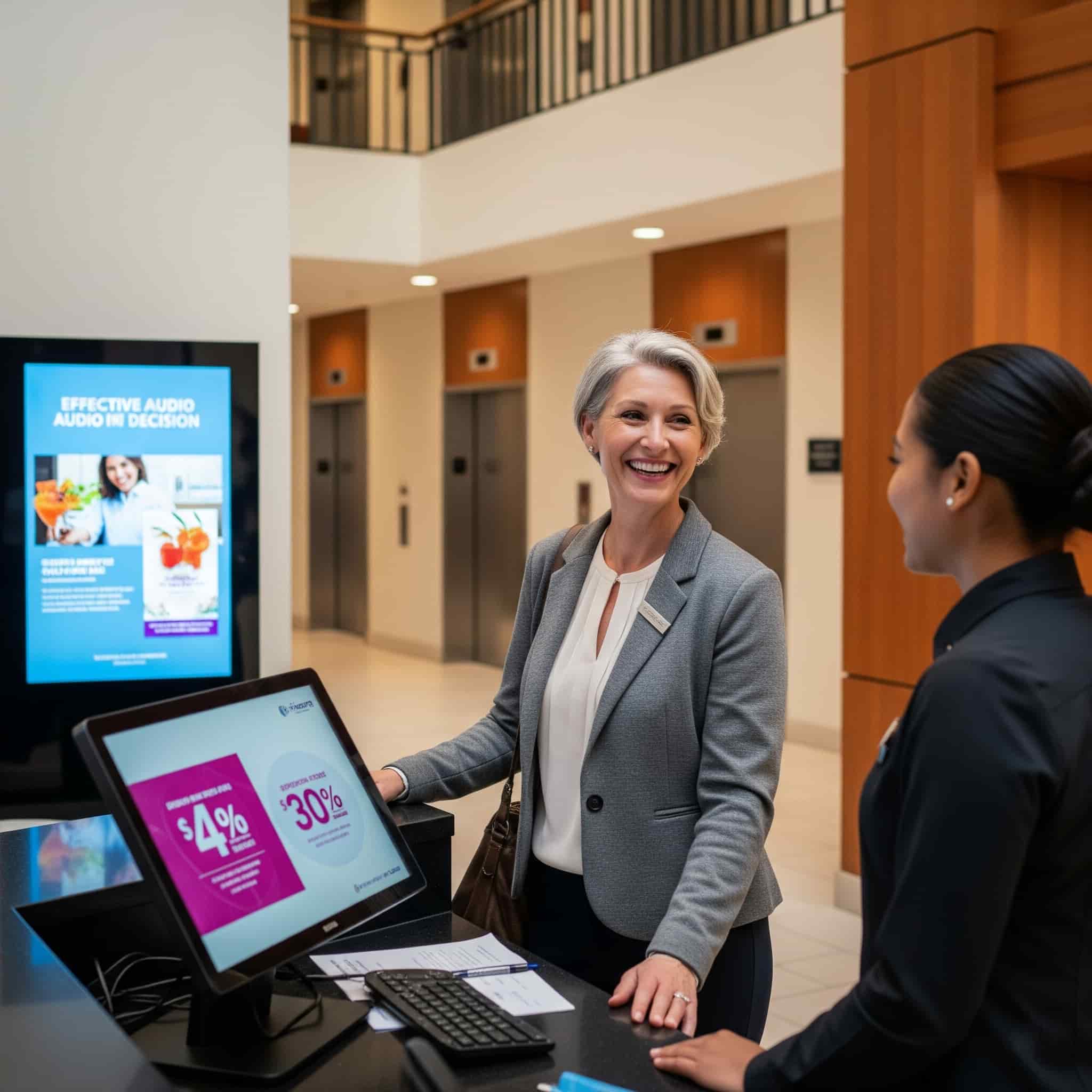
Here the guest is interacting with staff, exchanging information, making small decisions (upgrade, breakfast time, parking). The sonic environment must be present enough to soften the background but quiet enough to let the conversation with the receptionist feel unhurried. This is also the touchpoint where multilingual announcements can welcome international guests in their own language — a detail that rarely happens in European hotels and that guests notice immediately when it does.

Role: support the conversation, acknowledge the language of the guest.
03
Touchpoint 03

Corridors and elevator

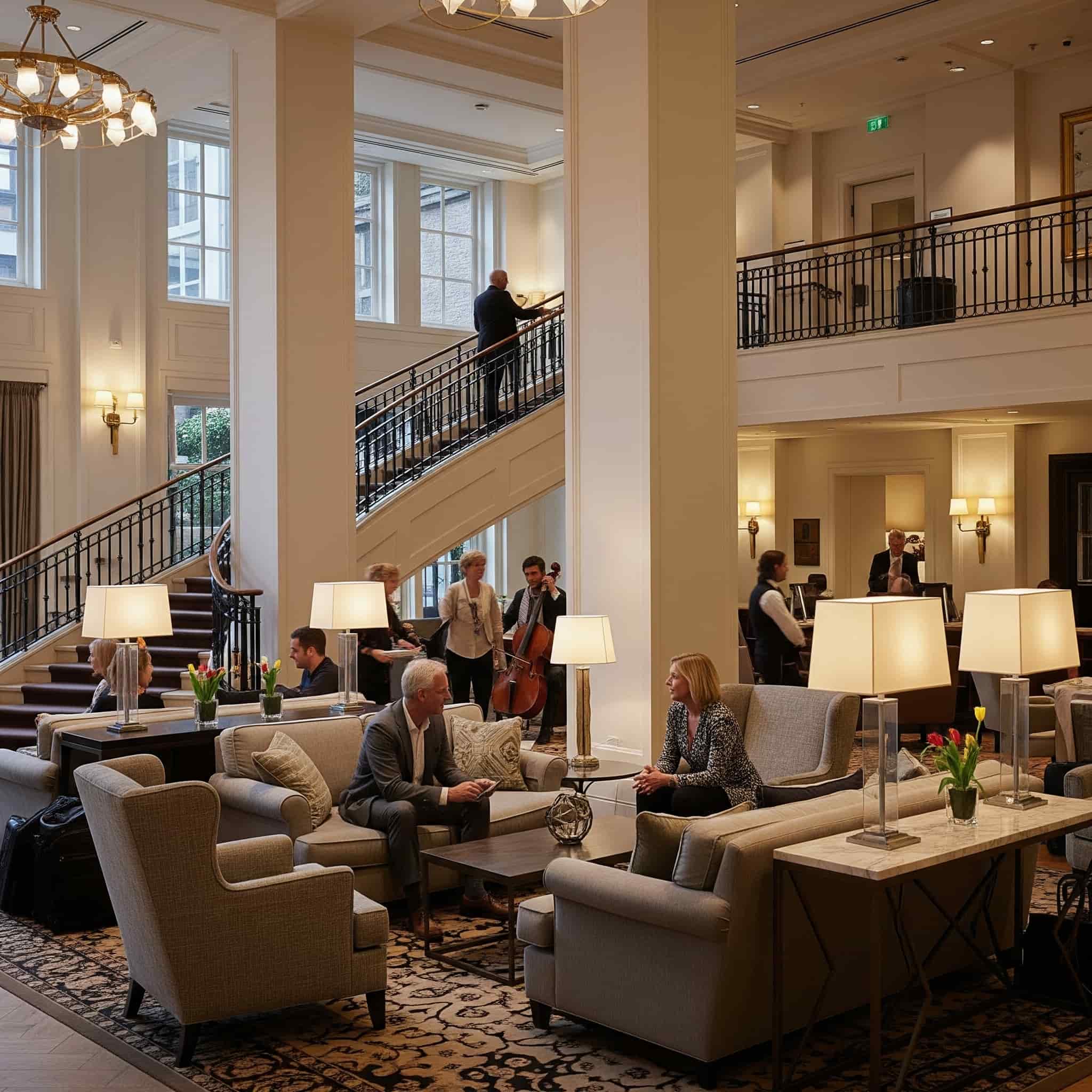
Often overlooked because it's a transit zone, but the corridor is also where guests form their impression of the hotel's attention to detail. A corridor in total silence feels austere, almost clinical. A corridor with generic commercial radio feels cheap. A corridor with a discreet, continuous sonic thread consistent with the lobby feels like part of a thought-through experience.

Role: continuity, avoid cold transitions between spaces.
04
Touchpoint 04

Breakfast room

One of the highest-stakes touchpoints of the day. According to the J.D. Power hospitality satisfaction research, breakfast is one of the strongest drivers of mid-scale hotel ratings. The mood here should be awake but soft, social but not intrusive, and should let conversations flow across tables without sounding empty in quiet moments. Announcements here can communicate breakfast hours, nearby activities, daily weather in the guest's language.

Role: start the day well, signal care and calm.
05
Touchpoint 05

Bar and lounge

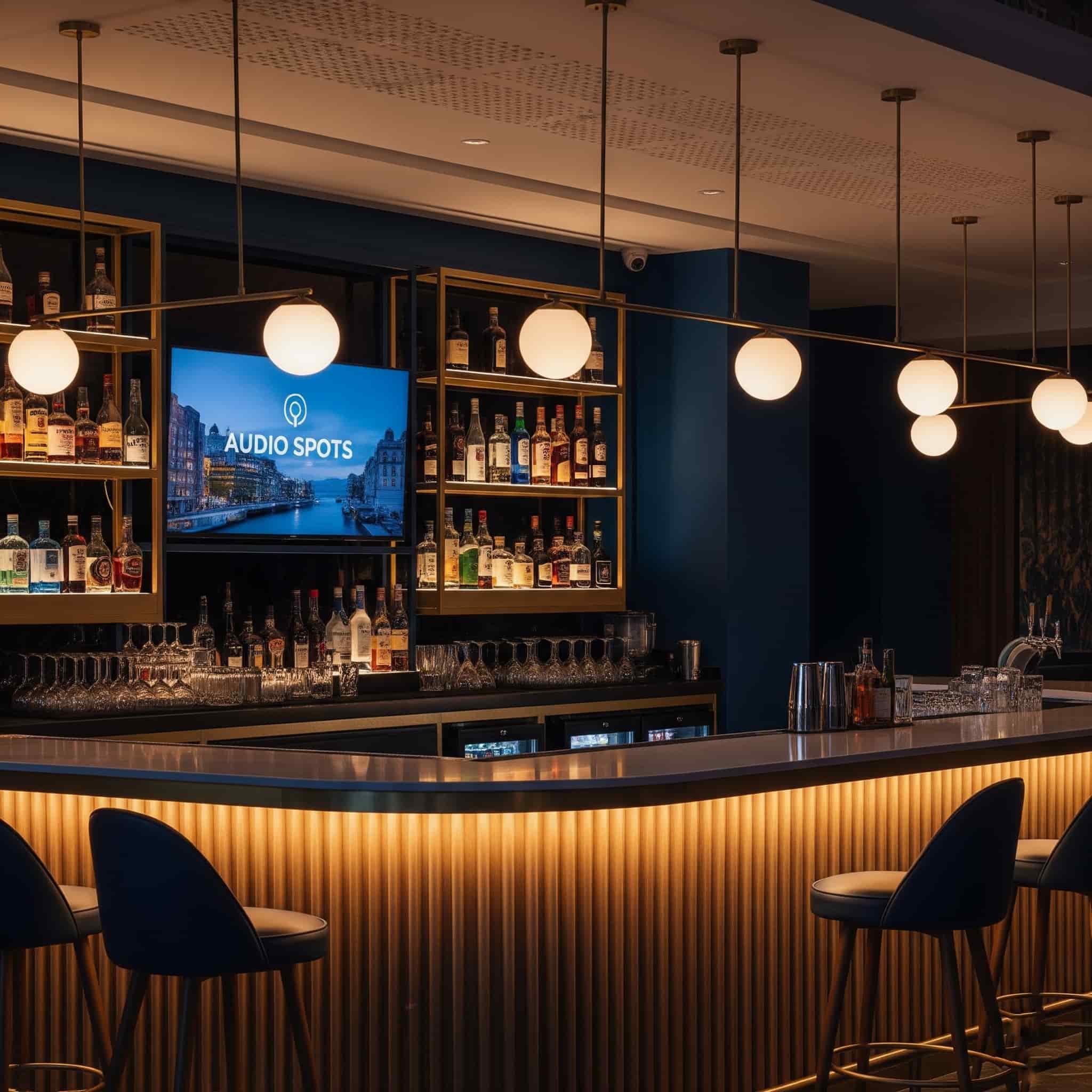
The bar is where the hotel earns a substantial share of its ancillary revenue and where the guest experience shifts from service to leisure. The mood evolves through the day: sophisticated calm in the late morning, energetic warmth in the early evening, refined nightlife after dinner. A single bar playlist that doesn't change through the day is a missed opportunity — the bar should sound different at 11am, 7pm and 11pm.

Role: dwell time, accessory revenue, sophisticated atmosphere.
06
Touchpoint 06

Spa and wellness areas

The most sound-sensitive zone in the entire property. Here the music isn't background — it's the central sensory element of the experience, because guests have deliberately chosen to be in a state of reduced visual stimulation. Research on sound and stress reduction, such as the meta-analysis by de Witte et al. (2019) published in Health Psychology Review, documents measurable physiological effects of carefully chosen music on guests in relaxation settings. Spa music should support sound masking of neighbouring cabins and reinforce the bubble of privacy each guest needs.

Role: deep relaxation, sound masking, acoustic privacy.
07
Touchpoint 07

Check-out and departure

The final impression. The guest is leaving, carrying with them the sensory memory of their stay. A warm, reassuring check-out atmosphere is the last sonic touchpoint that contributes to their likelihood of leaving a positive review and of returning. Many hotels underinvest in this moment because they consider it "over", but the final 90 seconds of a stay are statistically among the strongest drivers of memorable impression.

Role: positive closure, memorable final impression.

The seven-touchpoint framework is applicable to most hotel formats with minor adaptations (resorts, city hotels, design properties, business hotels). Specific zone counts may differ — a boutique property may have fewer zones, a large resort may have more — but the logic of a continuous, modulated sonic journey applies across the category.

A radio broadcaster's view on hotel audio

There's a useful parallel between a hotel stay and a radio listening session. Both are temporary, both accompany a transitional state in the listener's life, and both succeed or fail on the quality of the sonic journey they build for their audience.

The hotel as a sonic journey, seen from inside the broadcasting industry

Emanuele Carocci is an Italian radio broadcaster with over 20 years of experience in commercial radio, the last 10 at RTL 102.5 — one of the largest Italian national radio networks — where he co-hosts "La Famiglia Giù Al Nord" from Monday to Friday, 9am to 11am. He leads the music curation team at My Corporate Radio. His perspective on hotel background music comes from the discipline of building radio programmes for listeners who are in transit — in their cars, in their kitchens, at work — and who are using the radio as a companion to a specific moment of their day. A hotel stay, in his view, is exactly that kind of moment: the guest is in transit through life, away from home, open to the atmosphere of the place they're staying in.

"A hotel is a temporary home that your guest has decided to trust for one or more nights," he summarises the principle he applies to hospitality projects. "That trust is built through many signals, and sound is one of the most continuous. A radio programme lasts two hours and has to hold the listener's attention through every minute. A hotel stay lasts thirty hours or seventy hours or more, and has to hold the guest's impression through every one of those hours. The mechanics are surprisingly similar: you build a sonic world that the listener recognises, you modulate it through the different phases of their experience, and you make sure it never stops feeling intentional."

The music curation team at My Corporate Radio applies the same disciplines used in building radio formats to the design of hotel audio environments: mood progression through the day, coherent identity across zones, careful handling of transitions, integration of spoken announcements as if they were the "talk segments" of a radio programme. It's a broadcasting craft applied to a physical environment instead of to FM frequencies, and it produces an audio experience that feels like a thought-through whole rather than a collection of disconnected playlists.

Multilingual announcements: the feature international hotels actually need

The single feature that matters most to international hospitality properties is the ability to communicate with guests in their own language without hiring additional multilingual staff. This is where AI-powered text-to-speech becomes a practical rather than a theoretical advantage.

A hotel in a European capital receives guests from dozens of countries in the same week. The receptionist speaks English, possibly one or two other languages, definitely not fifteen. The guest who just arrived from Tokyo, from Seoul, from Riyadh, from São Paulo receives a welcome in English — which they understand, but which also immediately signals that the hotel isn't quite set up for their specific language. The same happens with breakfast hours, with spa availability announcements, with special offers, with safety reminders. Everything is delivered in English or in the local language, on the implicit assumption that the guest will adapt. Most of them do. But most of them also notice when a hotel adapts to them, and the ones who do notice remember the property much more vividly than those who don't.

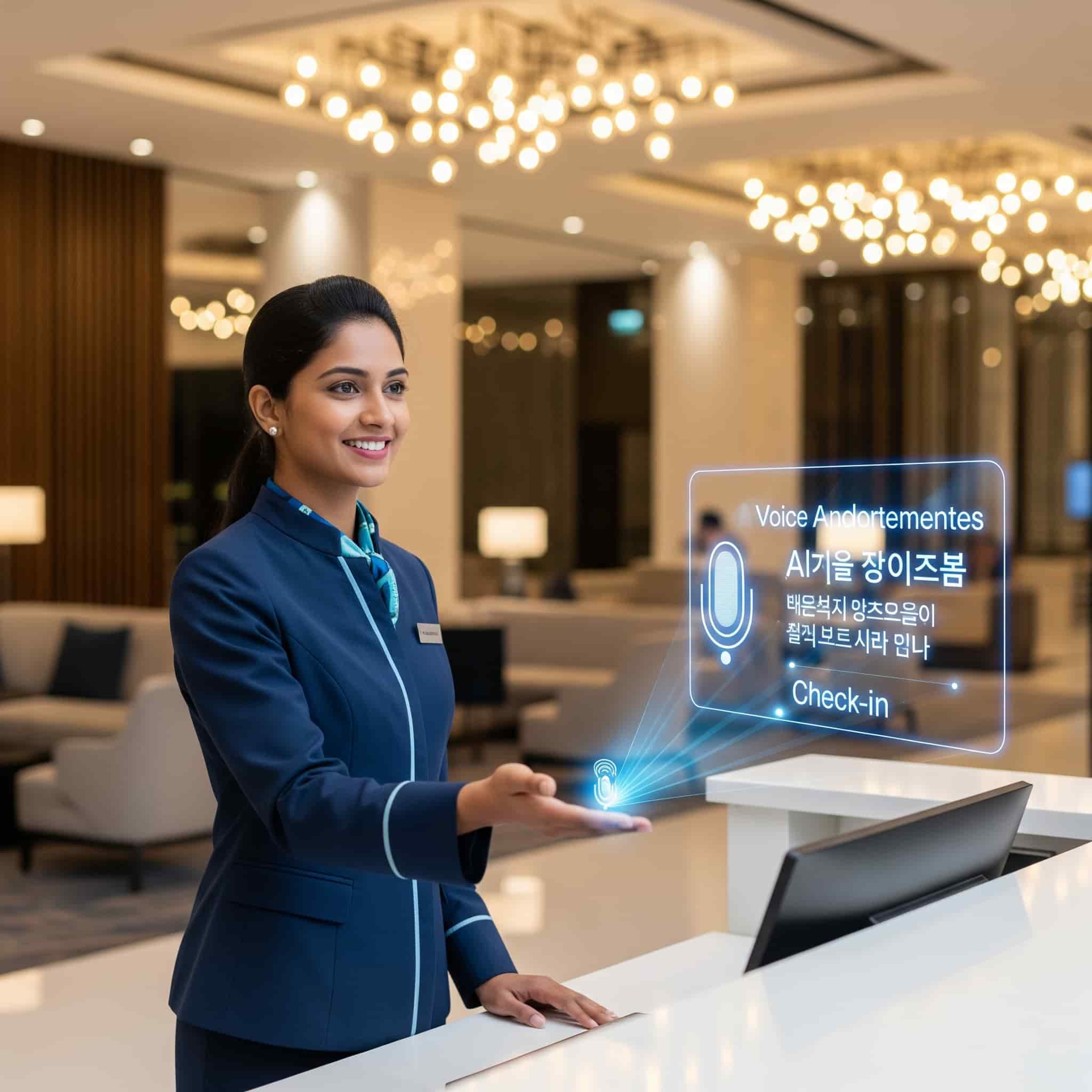
My Corporate Radio includes a text-to-speech module based on neural voice synthesis that generates natural-sounding spoken announcements in 14 languages: English, Italian, German, French, Spanish, Portuguese, Dutch, Polish, Turkish, Russian, Arabic, Chinese, Japanese and Korean. The hotel writes the message once in its working language, and the system produces the same announcement in all the languages the property needs. A welcome message, a spa opening reminder, a breakfast extension, a weather alert, an evacuation drill reminder — all of them can be generated and updated in minutes from any device, without recording sessions, without freelance voice-over budgets, without the coordination overhead that makes multilingual hospitality communication traditionally impractical. The guest from Tokyo hears the welcome in Japanese. The guest from São Paulo hears it in Portuguese. The guest from Riyadh hears it in Arabic. None of them had to ask for it, and all of them will remember that they didn't have to.

Direct licensing: why PRS, PPL, Siae and Scf aren't an issue

Music licensing in a commercial environment is one of the most opaque and overlooked aspects of running a hospitality property. Different countries have different collecting societies, different fee structures, different inspection protocols. The direct licensing model bypasses the question entirely.

In most European and English-speaking markets, playing commercially released music in a hotel requires paying two separate types of rights holders. The first is authors and composers, administered by societies such as PRS for Music in the United Kingdom, ASCAP, BMI and SESAC in the United States, GEMA in Germany, SACEM in France, SIAE in Italy. The second is performers and producers, administered by societies such as PPL in the United Kingdom, SoundExchange in the United States, GVL in Germany, SCF in Italy. Every hotel that plays commercial music in its public spaces is technically required to pay both streams, through the local collecting societies. The exact fees depend on property size, number of speakers, number of screens, hours of operation and local tariff structures — meaning the total cost is rarely a simple round number, and hotels with multiple properties in multiple countries face the burden of multiple separate licensing negotiations.

Direct licensing removes this entire layer. My Corporate Radio operates under a direct licensing model, equivalent to Italy's D.Lgs. 35/2017 transposition of the European Directive 2014/26/EU (known as the Barnier Directive), which liberalised the market of collective rights management across the European Union. Under this model, the producer of the music retains all rights and grants them directly to the end user — the hotel — as part of the subscription contract. Collecting societies have no claim on the specific repertoire supplied by My Corporate Radio, regardless of the country in which the hotel operates, because that repertoire has never been placed under their administration in the first place. For an international hotel group, this means a single licensing relationship covers all properties across all markets, replacing what would otherwise be a separate administrative burden in each jurisdiction. The subscription contract itself is the licensing documentation, available for inspection by any local authority.

Sources: Directive 2014/26/EU of the European Parliament and of the Council on collective management of copyright and related rights; Italian Legislative Decree 35/2017 implementing Directive 2014/26/EU; published tariff structures of PRS for Music, PPL, ASCAP, BMI, GEMA, SIAE and SCF. This page does not constitute legal advice but a general summary of the direct licensing framework applicable to My Corporate Radio's service.

Frequently asked questions

Why does background music matter in a hotel?

Because hotels are one of the most sound-sensitive commercial environments in existence. A guest's perception of quality is built from many subtle signals: lighting, scent, temperature, textures, and sound. Background music is the single most overlooked of these signals, yet it operates continuously through every touchpoint of the guest journey from arrival to check-out. When it's well curated, it reinforces the brand; when it's missing or generic, it weakens every other investment the property has made in design and service.

Do I still need to pay PRS or PPL if I use My Corporate Radio?

No, not for the music provided by My Corporate Radio. The repertoire is distributed under a direct licensing model: the producer retains all rights and grants them directly to the end user (the hotel) as part of the subscription. Collecting societies such as PRS for Music, PPL, ASCAP, BMI, GEMA, SIAE and equivalent bodies have no claim over the specific repertoire supplied, because that repertoire has not been placed under their administration. If a hotel also plays additional music from sources outside My Corporate Radio (for example a television tuned to a commercial radio station), those sources are still governed by the normal licensing rules of the relevant market.

Can I use Spotify or Apple Music for background music in my hotel?

No. The terms of service of Spotify Free, Spotify Premium, Spotify Family, Apple Music, YouTube Premium and Amazon Music explicitly restrict usage to personal and domestic use and prohibit public or commercial broadcasting. A hotel lobby, lounge, restaurant, spa and room corridor are all commercial environments open to the public. Using a consumer streaming account in any of these spaces is a breach of the platform's contract with the user, regardless of the separate question of public performance rights. A hotel needs a commercial background music service with a dedicated license from the outset.

How does the multilingual announcement system work?

My Corporate Radio includes a text-to-speech module based on neural voice technology that generates natural-sounding spoken announcements in 14 languages: English, Italian, German, French, Spanish, Portuguese, Dutch, Polish, Turkish, Russian, Arabic, Chinese, Japanese and Korean. The hotel types the message once in its working language and the system generates the same announcement in all the languages needed. Typical uses include welcome messages, breakfast and spa hours, special offers, and check-out reminders. For a hotel with a mixed international clientele, this is often the single most valuable feature of the service.

Can I monetise my hotel radio by selling sponsored announcements?

Yes, this is one of the features available on the enterprise plans of My Corporate Radio. Hotels with substantial guest traffic can host sponsored announcements from non-competing local partners: fine restaurants, luxury boutiques, wineries, tour operators, car rental services. These brief partner messages are inserted between music tracks in agreed time slots, generating an accessory revenue stream. The feature is not part of the entry-level Background Music Start plan at 9.99€/month; it is part of the tailored enterprise solution where it is activated together with dedicated editorial curation and multi-property coordination.

Which plan fits your property?

For a single-property hotel or boutique with standard needs, the base plan covers everything with direct licensing included. For hotel groups, chains and properties with structured brand identity, the tailored solution includes dedicated editorial curation, multi-zone management and enterprise features.

Hotel groups and chains

Tailored hospitality solution

For hotel groups, chains, boutique properties with brand identity to protect, multi-zone audio management.

  • Dedicated editorial curation for brand concept
  • Multi-zone audio management (lobby, bar, spa, restaurant)
  • AI-generated announcements in 14 languages
  • Multi-property centralised dashboard
  • Direct licensing documentation included
Tailored quote
Request a quote →

Response within 24 hours

Related reading

Italian-language guides from the My Corporate Radio editorial catalog on hotel audio branding and related topics.